
What Did We Discuss at the KlinBiS Founding Meeting?
The Clinical Biostatistics Association (KlinBiS) began its scientific journey with its Founding Meeting held in Mersin on 21 August 2026.
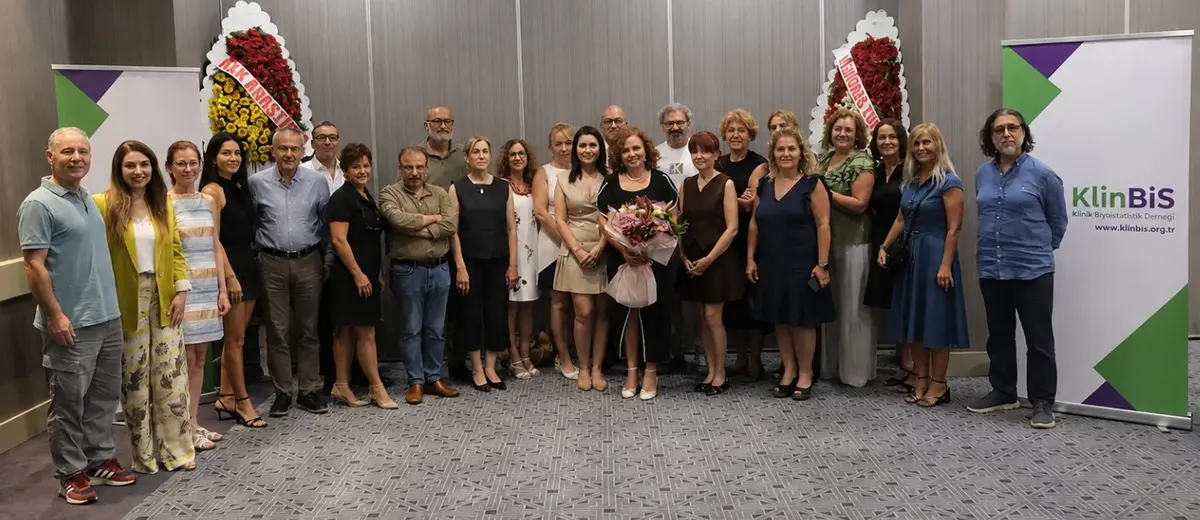
Alongside KlinBiS founding members and General Assembly members, the meeting brought together the President of the Mersin Medical Chamber, representatives of medical specialty associations, faculty members from departments of biostatistics, medical history and ethics, a representative of a clinical research organisation (CRO), and representatives of Anadolu Agency. It opened with a moment of silence and the Turkish National Anthem.
By bringing different disciplines and stakeholders in clinical research under one roof, the Founding Meeting established KlinBiS’s first official governing bodies and discussed the Association’s scientific priorities and roadmap for the period ahead.
The discussions focused particularly on the position of biostatistics within medicine and health sciences; its place in undergraduate and specialty medical education; CORE 2027; the biostatistics workforce; employment beyond academia; collaboration with industry; international research funding; and the evolving role of the biostatistician in the age of artificial intelligence.
Where Should Biostatistics Be Positioned in Medical Education?
One of the central discussions was that biostatistics education cannot be addressed adequately by asking only, “In which year and for how many hours should it be taught?”
The essential question is which biostatistical competencies physicians need at different stages of their educational journey, why they need them and when they need them.
Because the learning outcomes for biostatistics have not been defined within a clear and common standard in Türkiye’s National Core Curriculum for Undergraduate Medical Education, the scope and content of undergraduate biostatistics education may vary between faculties.
At undergraduate level, within an evidence-based medicine approach, the emphasis is on enabling students to read scientific research, assess the level and quality of the evidence produced, understand uncertainty and interpret evidence in relation to clinical decisions.
During specialty training, another vital competency is added: the ability to conduct research and generate scientific evidence.
A resident is no longer only a physician who reads published research. The resident transforms a question arising from clinical practice into a research question; plans a thesis or scientific study; defines the appropriate design, variables and clinical outcomes; justifies the sample size; generates data; analyses results; and interprets findings together with their uncertainty.
For this reason, undergraduate and specialty education are not alternatives within the KlinBiS educational approach; they are consecutive stages of the same continuum.
Every Specialty Has Different Needs
Another important conclusion was that clinical biostatistics education during specialty training cannot follow a single uniform model.
The clinical questions, research designs, data structures and outcomes encountered by a cardiologist, anaesthesiologist, surgeon, psychiatrist or radiologist are not the same.
The goal should therefore not be to repeat the same biostatistics programme for every resident, but to build specialty-specific clinical biostatistics competencies on a shared methodological core.
This approach also forms the foundation of CORE 2027, one of the meeting’s principal agenda items.
Two Decades of Experience Will Be Transferred to KlinBiS through CORE 2027
An important feature of CORE 2027 is that it will not start from zero.
The meeting reviewed how the researcher education initiatives started by KlinBiS Founding President Prof. Dr. Arzu Kanık—who led the establishment of MedicReS twenty years ago and continues to serve as MedicReS Global Scientific Director—have developed into an international structure. Programmes delivered in Türkiye during the past decade have created a training cohort of approximately 15,000 people and a substantial body of experience.
One of the key topics was the use of results from this cohort and nearly twenty years of international researcher education experience as scientific input for the newly established KlinBiS under CORE 2027, with KlinBiS undertaking the Türkiye component of CORE 2027.
Previous experience and data will be combined with the methodological expertise of biostatisticians and the perspectives of clinicians from different medical specialties.
The aim is to define the core clinical biostatistics competencies required across medical specialties through scientific methods and to establish the foundation for a sustainable educational model in Türkiye that is responsive to the needs of each specialty.
Why Are Too Few Young People Entering Biostatistics?
The discussions were not limited to biostatistics education for clinicians; the future of the field itself was also on the table.
Particular attention was given to limited academic growth in biostatistics and the insufficient number of young people choosing master’s and doctoral programmes in the field.
Rather than explaining this picture only through young people’s preferences, the meeting emphasised a question we must ask ourselves: What kind of professional future can we offer a young person considering a master’s degree or doctorate in biostatistics?
In Türkiye, the professional role of the biostatistician is defined largely within academia. Biostatisticians become academics; teach; provide methodological and statistical support to scientific research; perform analyses; contribute to theses; and serve on ethics committees.
All of these are essential and indispensable roles. However, if the only professional destination for expertise in a scientific field is an academic position, the growth of that field becomes limited by the restricted number of university posts.
If we want young people to pursue master’s and doctoral education in biostatistics, we must show them not merely the possibility of an academic position, but a real and diversified professional future.
Biostatisticians Need a Future Beyond Academia
Globally, the work of biostatisticians is not confined to universities.
Biostatistical expertise is needed across pharmaceutical and biotechnology companies, CROs, medical device and diagnostic technologies, clinical research organisations, health technology, R&D centres, data science, scientific technology development and independent consultancy.
The meeting emphasised the need to create sustainable employment opportunities and professional roles for biostatisticians in Türkiye that are independent of academia.
From the research question to design, from sample size to data strategy, and from analysis to the interpretation of evidence, the biostatistician should be one of the scientific partners of the team from the very beginning of a study.
We Must Show New Generations New Role Models
The meeting also discussed the need for young scientists to see a range of career examples if this transformation is to be achieved.
Alongside or outside an academic career, a biostatistics professional can develop software and scientific technologies, establish R&D structures, found a CRO, become an entrepreneur, work in industry or practise as an independent scientific professional.
Founding President Prof. Dr. Arzu Kanık’s own career was considered a tangible example of this approach: in parallel with academia, she led the establishment of MedicReS, developed structures in R&D, CRO and scientific technology, and continued her work as an independent biostatistics professional following early retirement from academia.
One of KlinBiS’s responsibilities will be to help transform such individual examples into a genuine professional ecosystem over time.
We Must Increase Employment of Biostatisticians in Industry
Employment of biostatisticians in the pharmaceutical and medical device industries, CROs and clinical research structures was another important meeting topic.
More visible roles for biostatisticians in clinical development, research design, data strategy and scientific evaluation are considered important both for the profession’s development and for Türkiye’s clinical research capacity.
One way to increase the attractiveness of postgraduate education in biostatistics is to demonstrate that this education has tangible professional value outside academia.
Türkiye Should Secure a Greater Share of International Research Funding
Research funding was also discussed at the Founding Meeting.
It was emphasised that developing Türkiye’s research capacity requires not only using available national resources, but also developing projects and partnerships of sufficient quality to attract international research funding to Türkiye.
KlinBiS aims to become a structure that monitors international funding opportunities, connects researchers with appropriate programmes and partners, contributes to the development of multicentre and international projects, and strengthens their methodological quality.
Artificial Intelligence: New Tools, More Statistical Thinking
Artificial intelligence was briefly considered within the rapidly changing environment of scientific research.
While AI’s potential to reduce language barriers in scientific communication and offer new opportunities to researchers was recognised as an important development, it was stressed that these technologies cannot replace statistical thinking.
The biostatistician of the future must be able to use AI tools while also questioning the uncertainty, validity and clinical meaning of the results they produce.
Scientific Boards Will Be Places of Production, Not Lists of Names
A shared view emerged that KlinBiS scientific boards should not be advisory lists containing names alone, but active structures that work and produce scientific outputs.
The boards are intended to lead work in education and curriculum, competency, accreditation, scientific standards, research quality and professional development, beginning with CORE 2027.
We therefore invite colleagues in biostatistics, as well as scientists working at different stages of the clinical research process, to serve on the KlinBiS scientific boards and become part of this production.
A Shared Goal: Good Medical Research
The discussions at the KlinBiS Founding Meeting demonstrated that the road ahead extends far beyond developing a single educational programme.
On one side is an educational model that progresses from the physician who can read and evaluate evidence to the physician-researcher who can generate it. On the other is a strong biostatistics professional who is part of the scientific team from the outset and has an independent professional role not only in academia, but also in industry, R&D, technology and clinical research.
CORE 2027, the scientific boards, access to international research funding, industry partnerships and adaptation to changing technologies will support this vision.
All these priorities converge at the same point: good medical research.
Good medical research is not simply a matter of choosing the correct statistical test. It is a holistic scientific process that begins with the right clinical question; is designed ethically, validly and reliably; is conducted with appropriate methods; accounts for uncertainty; interprets results correctly; and transfers the evidence it produces appropriately into clinical decisions.
The KlinBiS roadmap is to improve the quality of good medical research in Türkiye while expanding the sphere of influence of biostatistics and biostatisticians.
We invite you to grow with us the journey that began in Mersin on 21 August 2026.
Clinical Biostatistics Association – KlinBiS